Every space agency and company is trying to bring the Earth to the Moon — rockets full of supplies, fuel, equipment, people. This is a different question: what if we tried to build from what is already there? The materials exist on the Moon. The solar energy exists. Whether robots could ever be made reliable enough to use them — and whether humanity has the will to share what gets built — nobody knows yet. This is not a construction plan. It is an open invitation to think differently about a very hard problem.
I'm Berechja Kerkdijk, the founder of Chrystal Moon Base. This project is built on years of independent research and a deep conviction that the Moon should be open to all. Just a vision that refused to stop — and a concept that tries to show it might be physically possible. The real decisions belong to engineers and scientists who know more than I do.
I have a vision — that is all. This concept is built on years of independent research — not on a PhD, not on a laboratory, not on engineering expertise. I believe the Moon should be open to all of humanity. What you read here is my honest attempt to show that it might be physically possible. The real engineers still need to look at this.
And for as long as I can remember, I have been looking at the stars.
Driving through the night, stars above the cab, the same question kept coming back: why are we doing this wrong? Every nation races to be first. Every company patents what it finds. The best engineers are separated by borders. The best materials sit behind legal walls. Meanwhile the moon waits — neutral, unclaimed, belonging to no one.
"The moon belongs to no one. Therefore it belongs to all of us. Let us build it together."
— Berechja Kerkdijk, FounderThe ISS proved that former rivals can build what neither could alone. CERN proved that 23 nations can discover what one never would. The Human Genome Project decoded the blueprint of life — shared, open, for everyone. Chrystal Moon Base is built on that same principle. Neutral ground. Shared infrastructure. Open science. No nation owns it. No company monopolises it.
This project was built in hours outside of work, page by page, phase by phase, driven by one belief: we can do this better. Not faster — better. Not competitively — together. Not for one country or one company. For all of us.
// Slow But Sure. Not because it can be fast. But because it must be right.
Every technical decision in this project begins with one question: which place on the Moon makes the rest possible? After years of reviewing mission data from Clementine, SELENE, LRO and Chandrayaan, one location meets every criterion: the northern rim of Peary Crater at latitude 88.6°N. The lunar south pole (Shackleton · de Gerlache) is presented as the scientifically valid alternative, but Peary is the primary choice. This page explains why, with published sources.
The northern rim of Peary Crater is one of the most illuminated regions on the lunar surface. Published measurements from the SELENE (Kaguya) orbiter confirm that specific peaks on Peary's rim are in sunlight for up to 89% of a lunar year. This is not "eternal light" — no lunar location is illuminated 100% year-round because of the Moon's 1.5° axial tilt — but it is the most continuous solar exposure available anywhere on the Moon, combined with favourable thermal conditions on the near-Earth-facing side.
Crucially, Peary crater itself (the interior floor) is among the coldest places in the solar system at 30–40 K (−243 to −233°C). The adjacent small craters Peary B and Peary W are permanently shadowed regions (PSRs), confirmed by LRO Diviner thermal mapping. This gives Chrystal Moon Base a rare combination: near-continuous sunlight on the rim for energy, and extreme cold a short distance away for the thermal tunnel and water-ice mining — all within a few kilometres.
The thermal benefit of the pole versus the equator is decisive. Daily temperature swings on Peary's rim are approximately ±10°C, compared to ±125°C at the lunar equator. Structures, electronics and ceramic bonding experience far less fatigue. This is the difference between a site that requires constant thermal compensation and one where materials behave predictably for decades.
The southern lunar pole has attracted much of the current international attention (Artemis III, VIPER, Chandrayaan-3 landed nearby). The ridge between Shackleton and de Gerlache craters contains two points approximately 8 km apart that are collectively illuminated about 94% of a lunar year. Shackleton Crater itself is a deep PSR, containing water ice confirmed by LRO and the 2023 LROC/ShadowCam mosaic.
Why not Peary? Three reasons. First: the south pole sits within the South Pole-Aitken basin, a 2500 km impact structure with 16 km altitude variation — topographically more demanding than the relatively flat polar highlands at Peary. Second: individual illuminated areas at the south pole are smaller and more fragmented — typically a few hundred square metres per spot. Third: near-side Earth communication is less reliable from the far-side-leaning south polar sites.
Nevertheless, all Chrystal Moon Base technology is designed to be location-agnostic within polar constraints. If future mission data, international cooperation or regulatory factors favour the south pole, the same method, the same robots, the same dome standard and the same thermal-tunnel principle apply. Neither site is a commitment to exclude the other.
The choice of Peary Crater is driven first and foremost by energy. A site with 89% sunlight per year is a site where photovoltaics is the obvious primary solution. This is important because Molten Salt Reactor (MSR) technology, originally proposed for the base, is not commercially operational in the timeframe of the first construction phase. The decision to remain nuclear-free is the same one made throughout this project: the regulatory and political complexity of launching nuclear hardware on a non-governmental mission is not compatible with the open, international character of CMB.
The revised primary energy plan is therefore: thousands of photovoltaic panels deployed along the Peary rim on the illuminated peaks, with sufficient thermal and electrochemical storage to bridge the approximately 40 days per year of reduced illumination. Every kWh is produced on-site, from local regolith-processed silicon for the cells and locally smelted aluminium for the frames. No fuel imports, no reactor politics. A battery backup system handles safety-critical loads during rare illumination outages.
We are honest: thousand-panel arrays at 88°N are an engineering challenge. Dust mitigation, panel alignment under grazing sunlight, and storage for polar winter darkness all require dedicated solutions. These are addressed in the Phase 1 technical documentation and are the subject of the Phase 0 demonstrator programme. The point is not that it is easy — the point is that it is achievable with today's physics, without invoking reactor concepts that require a new regulatory universe.
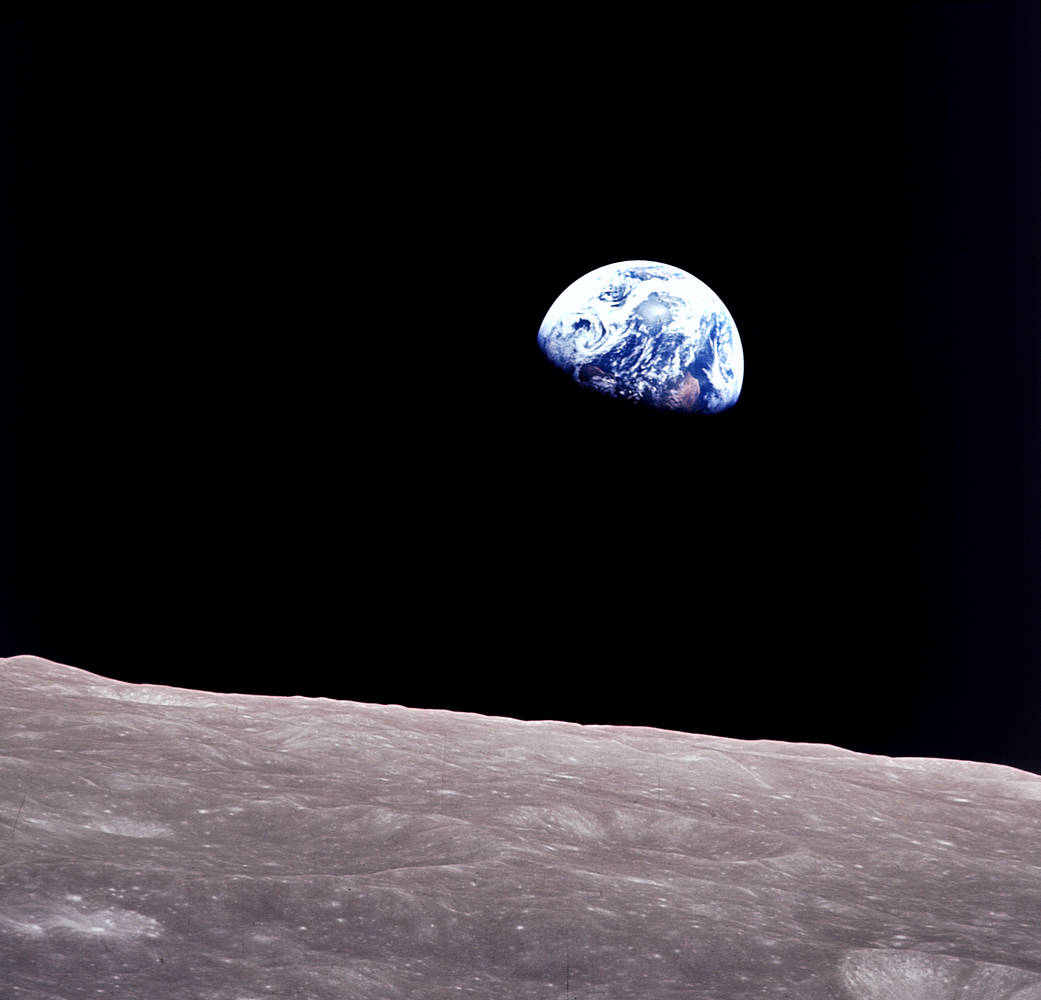
The Moon is not a single point on a map. It is an entire world — a continent of 38 million square kilometres, larger than Africa. If we ever build a lasting human presence there, it will not come from one base, one flag, or one purpose. This is one person's attempt to think about what that larger picture might look like — offered as an open question, not a plan.
"If the Chrystal Moon Base ever becomes real, it should not stand alone. This is a sketch of what a larger, open, multi-site lunar civilisation might eventually look like — each location chosen for what the Moon naturally does best there. It is a direction, not a promise. A question, not an answer."
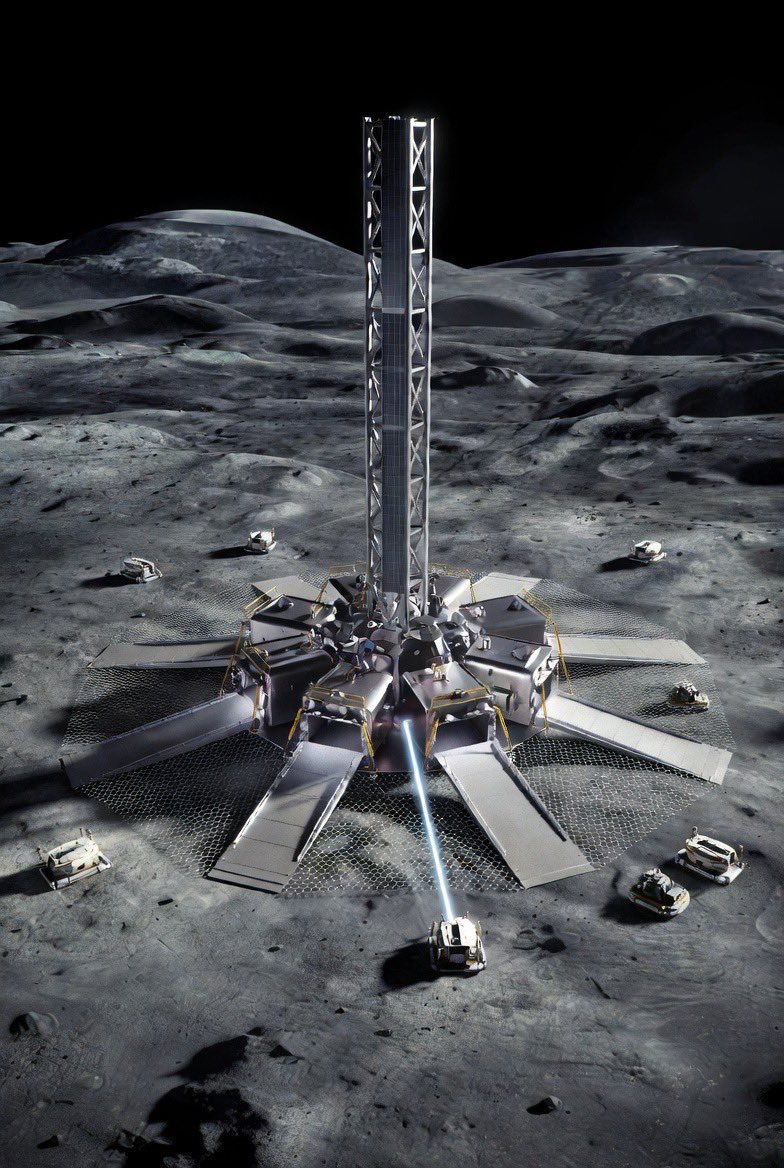
— Berechja Kerkdijk, Founder · Chrystal Moon Base · Civilisation Concept · Open DocumentAt the north pole, the rim of Peary Crater catches sunlight that almost never sets — the physics of this is real and well-documented. Whether a ~35-metre mast could one day stand here delivering ~129–177 kW to autonomous sintering robots is the question Phase 0 is trying to begin answering. If it works, this could be where the grid begins. If it works, Peary could become the energy hub of a much larger presence — proof that we can live on the Moon without importing a single watt from Earth. That "if" is enormous. But it is physically plausible.
Deep craters at the south pole hold permanent shadow and ancient water ice — this is confirmed by multiple missions. Water on the Moon is not just for drinking; it is potential rocket propellant, oxygen, and radiation shielding. Whether a sister outpost could eventually extract this ice and move it across the lunar surface is a question for engineers who are not yet involved. The concept is that Peary provides power; the south might one day provide the water. Both halves depend on things that do not yet exist.
Rockets need flat, clear ground — and the vast lava plains of the near side offer it. The physics of why the near-side equatorial zone makes sense for a spaceport is straightforward. Whether such a spaceport could ever be built — pads sintered from local regolith, berms shielding the habitats, a rail link running to the poles — requires decades of engineering that has not yet begun. This is the concept: that the Moon's natural geography suggests where things should go, long before we are anywhere near being able to put them there.
If humanity ever travels to Mars in serious numbers, launching from the Moon makes more sense than launching from Earth — the gravity well is shallower, there is no atmosphere to fight. The far side is shielded from Earth's radio noise, which makes it attractive for both deep-space departure and radio astronomy. This is not a plan. It is a question: if we get the earlier steps right, what might the Moon eventually enable? The honest answer is that we do not know. But the question seems worth asking.
This is not a master plan owned by any nation or company. It is an open-source concept sketch, published so that people who actually know what they are talking about can review it, correct it, and — if any of it is worth pursuing — improve it. The design thinking, the location reasoning, the phase structure: all of it lives in public repositories under open licences.
One founder wrote this down. That is all it is. If engineers, scientists, or institutions ever find something useful in it, that is more than enough. Every correction found, every better number provided, every simulation run brings this from a vision slightly closer to something real — or proves clearly why it cannot work, which is equally valuable.
No Flags. No Patents. No False Promises.
Just a question worth asking honestly.
This is a long-range concept developed by one person without academic credentials, laboratory access, or institutional backing. Every phase is described as honestly as possible: where the physics is solid, it is stated as such. Where the numbers are estimates or guesses, that is stated too. The goal is not to prove that this will happen exactly as written — it is to demonstrate that it is physically plausible, and to invite engineers, scientists and institutions to help turn it into something real. Every phase is a prerequisite for the next. No shortcuts. No compromises. The timeline estimates are illustrative only and depend entirely on funding, partnerships, and test results that do not yet exist.
Before any robot is sent to the Moon, every critical technology must be demonstrated on Earth under controlled conditions. Phase 0 is a programme of four physical demonstrators that together validate the core technology chain. These are not renders or simulations — they are real machines, real materials, real results. The central question of Phase 0 is simple to state and hard to answer: can a small swarm of autonomous robots, powered entirely by wireless solar energy, work together without human intervention to build something permanent? Every demonstrator below is a piece of that answer. No budget estimate is given here because no credible one exists yet. The cost depends on engineering decisions, partnerships, and test facilities that have not been determined. Quoting a number would be misleading. The purpose of Phase 0 is not to prove that the Moon base could be built — it is to prove that the fundamental technologies work as described, and to identify the unknowns that must be resolved before any Moon mission is designed.
Laser sintering of lunar regolith simulant at operational scale and depth. The energy required per cubic metre is one of the most critical unknowns in the entire concept.
A swarm of 2–4 prototype robots coordinating sintering path execution without human intervention. If it requires a human command, it fails.
Delivering usable electrical power to a moving robot receiver at 50–100 metres distance, with autonomous beam tracking.
A 5-segment telescoping mast (~35 metres) deployed to full height by a single motor, surviving 50 thermal cycles. The mast cannot be repaired on the Moon. It must work first time.
Fateri et al. (2019) Scientific Reports — EAC-1 laser sintering at small scale; PowerLight Technologies (2022) — laser power beaming ground demonstration; Honeybee Robotics LUNARSABER (2024) — lunar sintering robot concept at TRL 5
One Falcon Heavy. One pod. One ~35-metre mast. Sixteen robots. And the beginning of a sintered regolith floor that grows for as long as the sun shines. The concept envisions the MAST-POD landing autonomously at a high-illumination peak on the Peary Crater rim. The mast deploys. The robots walk out. They begin building — ring by ring, like a tree counting the years it has stood.
Everything designed, built, and tested on Earth before launch. If it works, three more pods follow. If it does not, we learn exactly why — and that is worth something too.
Eight autonomous robots, powered by laser from the mast, sinter the lunar regolith into permanent sintered regolith. No fuel. No oil. No human intervention. Full specification on GitHub.
The Spike, Pure Bloom, Adaptive Bloom, and Rooted Hybrid. Four different answers to the same problem: how do you anchor a ~35-metre mast permanently to the Moon? Which one flies is a decision for engineers. All four are documented in full.
A telescoping carbon-fibre mast with a vertical CIGS solar curtain tracking the sun in azimuth. At Peary latitude, near-continuous sunlight. Near-continuous power. The robots never stop.
Phase 1.1 cannot begin until Phase 0.2 has proven that the pod works on the actual lunar surface — not in a simulation, not in a test chamber, but on the Moon. It also requires a space agency or major institutional partner willing to provide launch and landing capability at the required scale. Neither of these conditions exists today. This phase is described as a direction, not a plan. The timeline is speculative. The description is honest about what it depends on.
NASA LEAG Concept Exploration — Peary rim illumination; Carrier, Olhoeft and Mendell (1991) Lunar Sourcebook Ch.9 — regolith geotechnical properties; Noda et al. (2008) Geophys. Res. Lett. — SELENE illumination data
Phase 1.2 begins only after Phase 1.1 has produced a stable, dust-free sintered platform and confirmed that the robot fleet can operate autonomously for extended periods. The infrastructure of Phase 1.1 is the prerequisite for everything here. Phase 1.2 establishes the industrial processing capacity that makes CMB genuinely independent of Earth supply chains. Thirteen specialised M-Modules extract iron, aluminium, silicon, titanium, magnesium, calcium, oxygen, hydrogen, water, helium-3, nitrogen, carbon and sulphur from lunar regolith. The chemistry for most of these processes is established at laboratory scale — the challenge is building equipment that works reliably in lunar vacuum, at lunar temperatures, operated by robots, without human maintenance, for years at a time. That gap between laboratory chemistry and industrial lunar operation is enormous. It has never been crossed for any process. This phase is described in the spirit of setting a direction, not making a promise. The 13 modules are the target; how many actually work, and when, is something that only decades of engineering can answer.
Schwandt et al. (2012) Planetary and Space Science — molten oxide electrolysis; Yoshida et al. (2009) — lunar ISRU nitrogen; Fa and Jin (2007) Icarus — He-3 distribution; Heiken, Vaniman and French (1991) Lunar Sourcebook — regolith composition
Phase 1.3 depends entirely on Phase 1.2 having successfully delivered structural metals, glass feedstock, and a reliable oxygen supply. Without those outputs, nothing here is possible. Phase 1.3 adds manufacturing capability to the base: the ability to produce complex components from locally sourced materials, without importing anything from Earth. Gen-4 robots operate electron beam melting (EBM) printers, CNC machining centres, and electron beam welding (EBW) systems — all designed to function in lunar vacuum without the inert atmosphere that these processes require on Earth. The 90–100 dome foundation positions are laser-engraved into the sintered regolith platform. This is described as a concept: the specific machines, their mass, their power requirements, and their reliability in the lunar environment have not been engineered. The purpose of this phase description is to show that manufacturing independence is a plausible long-term goal, not to assert that it will be achieved on any particular schedule.
Ding et al. (2019) Acta Astronautica — EBM in lunar environment; Taylor and Carrier (1992) — lunar glass production feasibility; Benaroya (2018) Building Lunar Habitats — dome structural concepts
Phase 2 requires Phase 1.3 to have demonstrated that the base can manufacture structural components from local materials. It requires a pressurised dome to have been tested robotically and proven stable for at least one full lunar year. And it requires a decision — by people who are probably not yet born — to send the first humans. None of that can be planned from here. Phase 2 is where the base becomes a place where people live, not just where robots work. It begins with a single 5-metre test dome — the first pressurised structure on the lunar surface — and ends, over many decades and many sub-phases, with a community of 500 permanent residents. Every dome is built to the Universal Dome Building Standard: five structural layers, geodesic fibre-reinforced frame, 72-hour autonomous life-support reserve. The city is not designed by one architect or one organisation — it is designed by the principle that every module must interface with every other module, and everything else is open to whoever builds it. This phase will not be completed by the founder of CMB. It will be completed by people who are children today, or not yet born. The description here is a direction, not a blueprint.
Hendrickx and Messerschmid (2018) Space Life Sciences — closed-loop life support; Hendrix et al. (2019) New Space — lunar settlement requirements; NASA TM-2014-218556 — ISS life support heritage
A permanent spaceport on the lunar surface changes the economics of deep-space exploration fundamentally. Launching from the Moon requires escaping only 1/6 of Earth's gravity well, with no atmosphere to fight through and no weather to delay operations. A universal spaceport — open to any rocket operator, any nation, any mission — turns the Moon from a destination into a waypoint. CMB proposes a spaceport built on the same open-platform principle as the base itself: standard interfaces published openly, any certified operator bringing their own adapter, no exclusivity. The infrastructure — platform, fuel, power, communications — is provided by CMB. The rocket, the payload, and the destination are the operator's business.
Sowers (2016) New Space — lunar propellant economics; Sanders et al. (2015) AIAA — lunar ISRU spaceport concept; Andrews et al. (2014) — HfC properties
The lunar surface receives constant micrometeorite bombardment without the protection of an atmosphere. For a robot-only base this is a manageable engineering problem: the domes are designed to survive impacts up to a certain size, and damaged sections can be repaired by robots. For a base with 500 permanent human residents, the risk profile changes. The Planetary Defense Network (PDN) is presented here as a conceptual study, not a near-term engineering plan. It raises genuinely difficult legal questions — the Outer Space Treaty prohibits weapons in space — that must be resolved before any such system could be built. The PDN as described is a detection and deflection system targeting astronomical objects, not a weapon. Whether existing space law accommodates that distinction is a matter for international lawyers and policymakers, not engineers. This phase is included because honesty requires acknowledging that a permanent lunar base faces risks that have no easy solution, and that thinking about them now is better than discovering them later.
Lubin (2016) JBIS — directed energy planetary defense; Wie (2008) Aerospace — asteroid deflection concepts; Outer Space Treaty (1967) Article IV — prohibition on space weapons
What began as a lunar base concept evolved into a question: if this method works on the Moon, where else does it work? The Chrystal Method — local materials, autonomous robots, modular construction, open standards, no ownership of the world itself — is not unique to the Moon. It is a general approach to building permanent human presence anywhere that has solid ground and access to sunlight or another energy source. This phase is the most speculative in the entire concept. It describes destinations that no human or robot has reached, using technologies that do not yet exist at the required maturity, on timescales that extend beyond any reasonable planning horizon. It is included because the vision that motivates this entire project is not a lunar base — it is the idea that humanity can become genuinely multi-planetary, on peaceful and cooperative terms, without repeating the mistakes of terrestrial colonialism. The Moon is the first test of whether that is possible.
Zurek and Smrekar (2007) — Mars ISRU; Hayne et al. (2015) Icarus — Mercury polar ice; Nimmo and Pappalardo (2016) JGR — Europa ocean; Tobie et al. (2014) — Titan habitability; Outer Space Treaty (1967) — legal framework
Scientifically verified resource analysis for every candidate world. Every claim is backed by published mission data and peer-reviewed research.
Silicates 40–50 wt%, iron oxide to 20 wt%, polar water ice confirmed, CO² atmosphere (95%) directly usable by hydrofarms. Most complete resource base after the Moon. Best locations: Hellas Planitia (89% higher atmospheric pressure), Arcadia Planitia (ice at 10 cm depth), Jezero Crater (carbonates confirmed by Perseverance).
PSR water ice confirmed by MESSENGER neutron spectrometry (2013). Adjacent crater rims receive 6.3× Earth sunlight — the most energy-rich LPB location in the inner solar system. Silicate crust and iron confirmed. Identical polar situation to the CMB lunar site.
The only moon in the solar system with its own magnetic field (720 nT) — partially shielding Jupiter's radiation belts. 50% water ice, 50% silicate rock. Combined with the five-layer dome: radiation dose comparable to Mars surface. Best Jupiter candidate.
Free nitrogen atmosphere at 146.7 kPa — no M-N2 module needed. Richest organic chemistry in the solar system. Water ice crust. Key adaptation: ice domes as alternative to glass where surface silicates are unavailable. Methane lakes at poles as potential energy source.
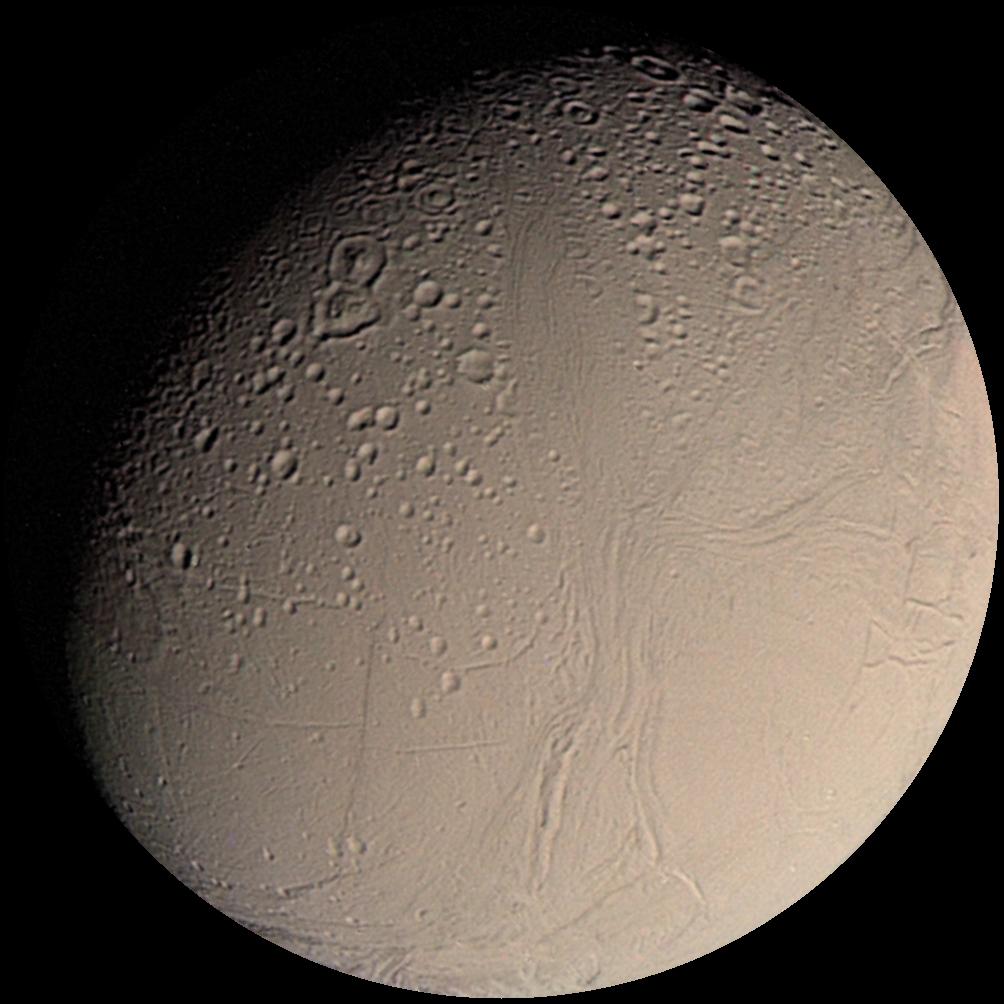
Active geysers of liquid water, hydrogen and organic molecules confirmed by Cassini (2017). Warm subsurface ocean with hydrothermal activity proven. Gravity 0.011g is the major challenge — EBM and EBW are the only viable fabrication methods. Unique astrobiology target.
Largest liquid water ocean in the solar system. Surface radiation: 5,400 mSv/day (lethal). Solution: fully underground ice tunnel base 10–15 m deep provides adequate shielding. Direct access to the subsurface ocean. The ultimate scientific destination.
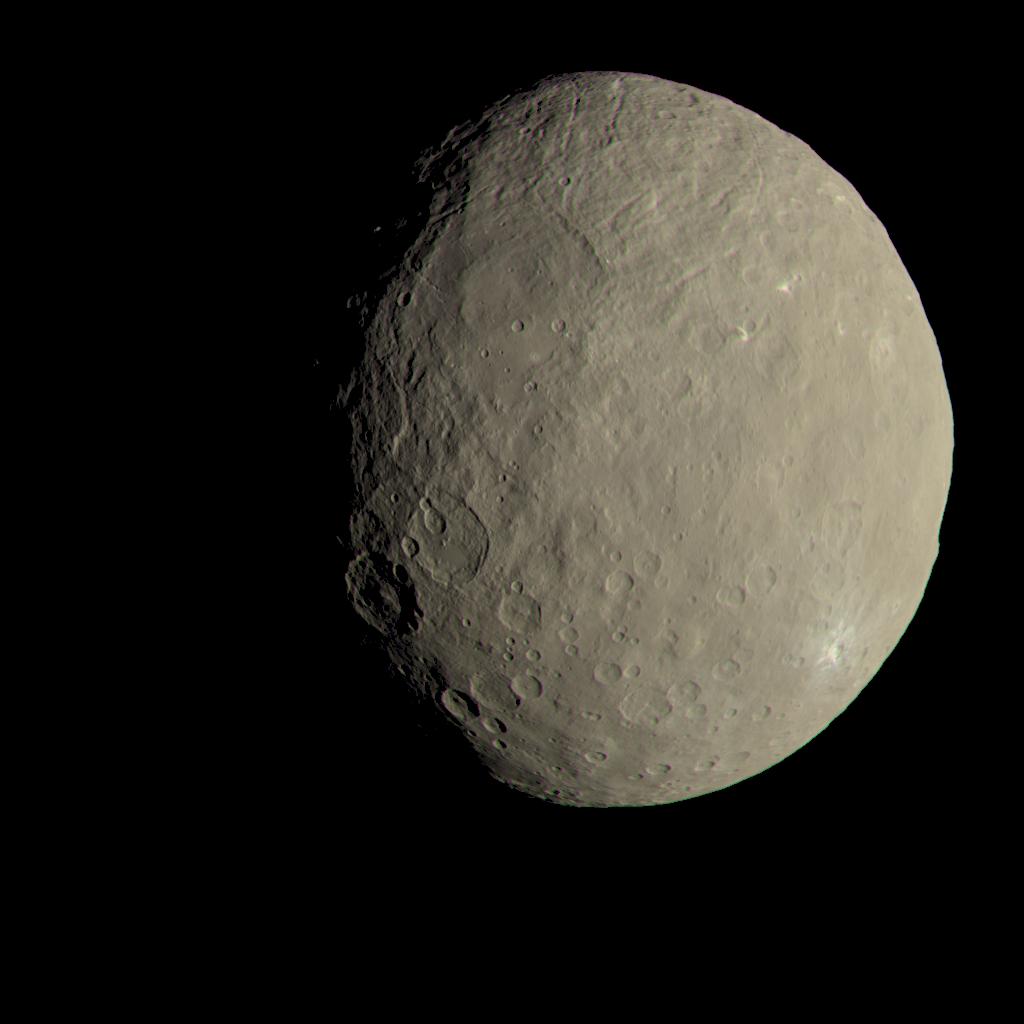
Wateriest body in the inner solar system (23 wt% water). Dawn spacecraft confirmed carbonates and ammonium salts (2015). Gravity 0.029g makes construction challenging. Strategic value as resupply station for outer solar system missions even if permanent habitation is limited.
Every space mission currently launches its materials from Earth at a cost of millions per kilogram. The Codex documents what the Moon already contains — the metals, ceramics, gases, and compounds present in lunar regolith that could replace every Earth import. This is not a wishlist. Each entry is grounded in published mission data from Apollo, LCROSS, SELENE and LRO. The question the Codex asks is simple: if you had to build a city using only what is already there, what do you have to work with? The answer is more than most people expect.
This is not corporate marketing. This is one person with a complete scientific plan asking the world to believe in it — transparently, honestly, with every detail openly shared.
Chrystal Moon Base currently consists of two things: a vision and hundreds of pages of technical documentation. To move from paper toward reality, the first real step is to build and film a proof of concept on Earth. That is Phase 0 — and that is what this campaign seeks funding for.
We are being completely transparent because you deserve to know exactly what your money does and what it cannot do. The full Phase 0 programme realistically costs €1.5–3 million across 3–5 years. Crowdfunding alone will not cover this; it funds the starting feasibility study and the most achievable first demonstrator, and it builds the public record that makes institutional partnerships possible. Running a multi-year research programme involves real costs — including part-time staff, lab rental, certified materials and insurance — and we will publish those costs openly.
placeholder
Phase 0 realistically requires €1.5–3 million across 3–5 years for the full five-demonstrator programme plus a scientific documentary. Crowdfunding is the starting fuel, not the finish line. Your donation funds the feasibility study, the first achievable demonstrator, and the groundwork needed to approach institutional partners.
You are not donating to a budget line. You are supporting an open-source attempt to prove that a lunar base, built from local materials by autonomous robots, is worth taking seriously. No guaranteed outcome. Full transparency on costs, progress and setbacks.
// Official website: www.chrystalmoonbase.com
Register your name. Stay updated on the project. Be part of the history being written.
You are registered as a Pioneer. Your name is reserved in the system.
This project only works if more people join it. Every engineer who spots a flaw, every scientist who can validate a number, every student who wants to contribute a calculation — this is where that happens. The hardware designs are open under CERN-OHL-S-2.0. Documents are CC0. The software is proprietary. Everything that can be open, is.
Review the MAST-POD concept documents. Find an error. Submit a correction. Every validated number makes this stronger.
The robot swarm logic, the sintering energy model, the terrain selection algorithm — none of these exist yet as code. Any contribution, however small, becomes part of the foundation.
The codex has 96 entries in 26 languages. The technical documents need review. Phase descriptions need improvement. Good writing is engineering too.
Phase 0 demonstrators are ground-test programmes that need facilities, equipment, and expertise. If your institution could host or support any part of this, the repository is the place to start that conversation.
Star the repository. Follow the progress. That is enough. Every star tells someone else this is worth looking at.
This project exists because one person refused to stop asking a question. The best thing that could happen now is that more people start asking better ones. If you have found an error in the calculations — I want to know. If you are an engineer, scientist or student and something here interests you — write. If you think the whole concept is wrong — explain why. If you just want to say something — say it. Every message is read personally. There is no team, no PR department, no filter between you and the founder. Just one Dutch founder who drives through the night thinking about the Moon, and who will read your email before the next shift.
A wrong number, a flawed assumption, a physics mistake. Tell me exactly what and why. This is the most valuable message you can send.
You work in photovoltaics, robotics, laser systems, regolith mechanics, thermal engineering, or anything relevant. You do not need to agree with the concept to write. A critical question from someone who knows the field is worth more than a thousand encouraging messages.
A calculation, a simulation, a paper, a prototype, a contact at an institution. Anything that moves the concept closer to something testable is welcome.
The gap between Phase 0 and Phase 0.2 cannot be crossed alone. If you see a role for your organisation in this project, the door is open. There are no preconditions for a conversation.
The story of building a lunar base from its own materials — designed by a founder — is open source. Use it. Share it. The more people who ask this question, the better.
That is enough. Write.
This project uses two separate licences — one for hardware, one for software. Neither is hidden. Both are explained here in full. If something is unclear, open a GitHub Issue or email us.
All mechanical designs, structural concepts, and physical documentation — the CMB8LF robot chassis, the mast, the pod, the domes, the processing modules — are open source under the CERN Open Hardware Licence Version 2 — Strongly Reciprocal. You may build it, modify it, and distribute it. You must attribute Nexus Ignis B.V. / Berechja Kerkdijk and share modifications under the same licence. All written documents are CC0 — public domain, no attribution required.
CERN-OHL-S-2.0 →The software that runs on the robots — sintering AI, swarm coordination, flight-critical guidance — is proprietary. No source code is published. This is a deliberate decision: the hardware being open allows anyone to build their own robot. The software being proprietary protects the organisation's ability to sustain itself over a very long development timeframe. This position may only change by public board resolution with 90 days notice.
Full notice →Chrystal Moon Base is the open-source initiative of Nexus Ignis B.V., a Dutch private company (besloten vennootschap) founded by Berechja Kerkdijk, alongside commercial 3D-printing and robotics divisions. The earlier plan to operate Chrystal Moon Base as a non-profit Stichting has been dropped. The hardware designs and documentation remain openly licensed as described above; the control and firmware software is proprietary.
Full legal structure →This project claims no ownership of any part of the lunar surface. The Outer Space Treaty (1967) Article II prohibits national appropriation of the Moon — CMB interprets this as applying to private entities as well. No licence granted here, and no hardware built from these designs, confers any claim to lunar territory. The Moon belongs to everyone. That is not a slogan. It is a legal and ethical boundary this project will never cross.
Read LEGAL-STRUCTURE.md →These licence documents describe the current project structure. Nothing here constitutes legal advice. If you are making decisions based on these documents, consult a qualified IP lawyer. If you see something that should be done differently, tell us.
All written documents — concept papers, technical overviews, one-pagers, governance documents — are CC0. No attribution required. Use freely.
CC0 →